Patriot Towers
Clayton Teeter, C.P. Ward
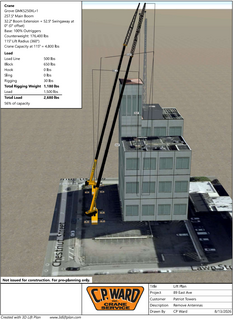
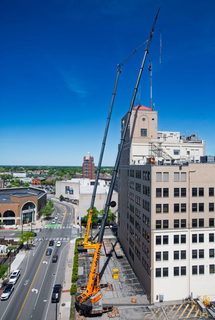
The details of this project were very tricky; we were asked to provide a crane to help Patriot Towers take down a 145’ steel monopole sitting
on top of a 165’ tall building. The tricky part of this pick was the job site; this building sits in the heart of downtown Rochester so setting
up on either of the streets next to this building was out of the question. That left us with only being able to set up in the parking lot, most
of the time that is not an issue, but this parking lot has two different elevations with a 4’ concrete wall separating the drop off. I used 3D
Lift Plan to find the exact spot the crane could sit where we were far enough away so that we weren’t boom bound and close enough so that we
had enough capacity to safely hoist the sections of this tower.
Ultimately once I found the best spot to cut across the side of the highest wall and reach over the top of the wall, I was able to run through
the different configurations of our GMK5250XL-1 with 176,400lbs of counterweight to find where it was strongest. Using 3D lift plan, I was able
to find that using our 32.2’ Boom Extension, 52.5’ swing away and the full 257.5’ of main boom was able to get up with enough tip height to attach
rigging and pick the top section of tower while being at only 56% capacity.
After submitting my first lift plan showing all of this, we were presented with our first issue from the safety department. Upon doing a site walk
with the lift plan in hand we had the underground utilities marked and found that one of our outriggers would be sitting directly on top of an
underground gas line. Using the typical 6’x8’ oak crane mats we typically use the ground bearing pressure under the outriggers was too high at the
time for what asphalt can withhold. Using 3D lift plan, I was able to find the solution of putting 10’x10’ steel road plates under our crane mats
to disperse the load even further. Doing this I was able to get the ground bearing pressure to 3,728 psf which was under the 4,176 psf that asphalt
allowed. This plan was found to be acceptable by all parties involved.
Two weeks before the job we got the biggest bomb of all dropped on us which is also when 3D lift plan became the most beneficial to me. The safety
team decided that it was unsafe for the Tower personnel to climb the tower and make their cuts and attach rigging. Because of this we needed to now
supply a second crane that could hoist a man basket with the tower personnel in it so that they could make all their cuts and attach their rigging
from there. The issue with this was that we were already using our longest boom crane and sitting in the best spot to hoist the tower down, so I
reached out to another crane company in the area that we had worked with before to see if we could rent a crane from them to hoist the man basket.
They had a GMK6300L-1 that was the perfect solution for this, however this is a crane I had never worked with before so I had no crane charts or
knowledge of what it could do. I solely used 3D lift plan to play around with every configuration the crane had until I found one that worked to
get the man basket where it needed to go.
I am supposed to be going to the 3D lift bootcamp in the next couple months which is great, but I am ultimately self-taught up to this point on
the program. I can’t express more how much I enjoy how easy to use it is and without it I would not have learned as much as I know now about crane
work. This project perfectly encapsulated this because without the help of this program I do not think we would have been able to overcome all the
challenges that arose along the way, and it was awesome to see the project play out exactly how I had planned it.